The laptop-on-the-beach version of remote life is easy to sell because it photographs well.
What does not photograph well is the client who disappears, the insurance claim that gets rejected, the visa issue that shows up too late, or the month when “freedom” starts feeling a lot like financial pressure.
That is the part most people skip.
The digital nomad dream is not fake. For the right person, it can be one of the best lifestyle upgrades you ever make. More flexibility. More choice. More control over where and how you live.
But moving abroad with the wrong setup can turn that freedom into a very expensive lesson.
Most people do not struggle because they are careless. They struggle because they prepare for the fantasy and ignore the infrastructure.
Before you book the flight, here is what digital nomads need to get right.
The digital nomad dream is real. The risks are too.
Everyone markets freedom.
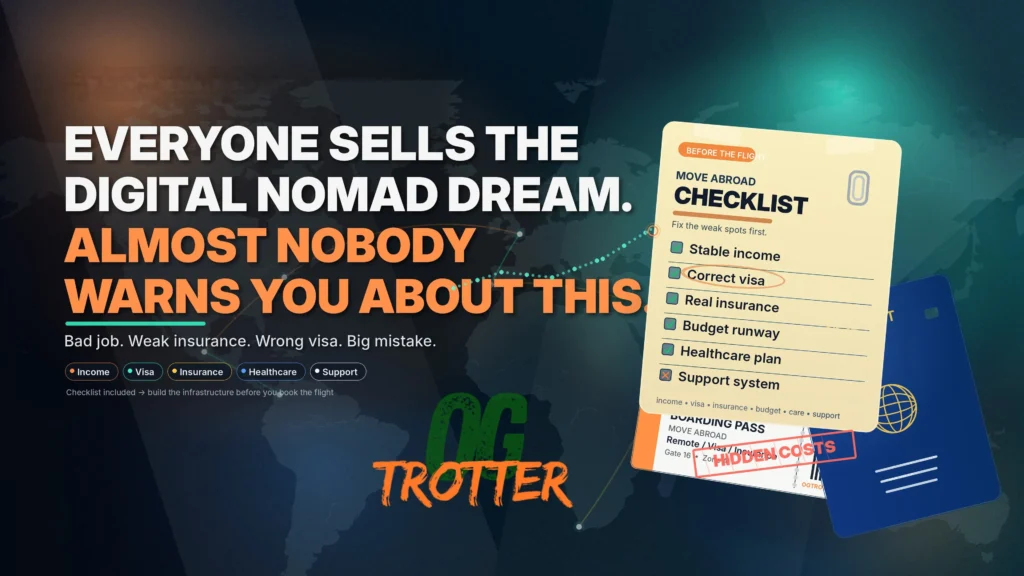
Very few people market the boring systems that make freedom sustainable: stable income, legal clarity, proper coverage, realistic budgeting, healthcare access, and a support system when something goes wrong.
That is where moves abroad succeed or fail.
A beautiful destination will not save a weak plan. A cheap apartment will not fix unstable income. A flexible lifestyle does not mean much if one emergency can wipe out your savings.
The dream is not the problem.
Bad planning is.
1. The wrong remote job can break the lifestyle fast
A remote job is not the same thing as portable income.
That is one of the biggest mistakes future nomads make.
Some jobs look flexible until time zones become brutal. Some freelance businesses feel solid until one major client leaves. Some people move abroad before their income is stable enough to survive a slow month, a delayed payment, or a change in workload.
The real question is not, “Can I work online?”
The real question is, “Can my income survive real life abroad?”
That means your work should be able to handle:
- time zone differences
- client delays or income fluctuation
- travel disruptions
- unstable internet or schedule changes
- the loss of one client or one employer
A strong digital nomad setup usually has three traits.
It is consistent.
It is portable.
It is not dangerously dependent on one single source.
Too many people move abroad because they are emotionally ready, not financially ready.
That is where the pressure starts.
2. Weak insurance is one of the most expensive nomad mistakes
This is where a lot of people try to save money, and it can backfire hard.
Many future nomads assume basic travel insurance is enough. Others skip coverage because they are healthy and assume they will deal with problems later.
That is not a strategy. That is hope.
The issue is not just catastrophic emergencies. It is the layer around them: urgent care, hospital stays, specialist visits, lost prescriptions, medical evacuation, coverage exclusions, or what happens when you move across multiple countries.
If your plan only works while you stay perfectly healthy, it is not a plan.
Before moving abroad, digital nomads need to think beyond the cheapest policy and ask better questions:
Will this actually cover the kind of life I am living?
What are the exclusions?
What happens across borders?
What happens if I need treatment now, not three weeks from now?
Cheap coverage often looks affordable right up until the moment you need it.
3. Poor visa planning can stop your move before it starts
This part is not exciting, which is exactly why people avoid it.
But poor visa planning creates some of the most preventable problems in the digital nomad lifestyle.
Every country has different rules, different timelines, different proof-of-income expectations, different stay limits, and different interpretations of what remote work means under that system.
The mistake is assuming it will all be simple once you land.
It often is not.
A lot of moves go wrong because people focus on flights, housing, and content inspiration while ignoring the one thing that determines whether the move is actually sustainable: legal clarity.
Before moving abroad, you need to understand:
- how long you can stay
- what documents you may need
- what proof of income may be required
- what your renewal or extension path looks like
- what you need to confirm before arrival, not after
This is the boring part of the move. It is also one of the most important parts.
The people who build the best life abroad are usually the people who respect the paperwork.
Planning your move abroad?
Get the free Digital Nomad Move Abroad Checklist and join the early-access list for our upcoming community.
You’ll get practical guidance on remote income, insurance, visa prep, healthcare, and the first steps that make a move abroad safer and smarter.
Form fields: First Name, Email Address
Button text: Get the Checklist
No spam. Just practical guidance and early community updates.
4. A “cheap country” can still become an expensive life
A lot of people build their entire plan around average monthly cost-of-living content.
That number is often incomplete.
The real cost of moving abroad is not just rent and food. It is deposits, visa fees, flights, setup costs, coworking, SIM cards, transport, banking friction, emergency travel, and the extra money people spend when they are new, tired, and trying to solve problems quickly.
Then there is lifestyle inflation.
Weekend trips. Short-notice flights. Better cafes. More convenience. Temporary housing that becomes long-term. Constant small upgrades that feel harmless until they quietly destroy the budget.
This is why smart nomads calculate two numbers:
The survival budget
What it costs to live safely and sustainably.
The real-life budget
What you are actually likely to spend once movement, comfort, mistakes, and unpredictability are included.
That gap matters more than most people realize.
5. Healthcare planning matters more than people think
Moving abroad is not just a work and housing decision.
It is a healthcare decision too.
That means thinking through routine care, prescription refills, emergency support, mental health access, medical records, and what happens when your body does not cooperate with the plan.
Freedom feels very different when you are sick, stressed, and navigating an unfamiliar system.
The best destination is not just the one that looks good online. It is the one where your life still works on a bad day.
That is the standard more people should use.
6. The hidden cost nobody talks about enough is isolation
There is another risk that does not show up on most checklists.
Loneliness.
A lot of future nomads assume the hard part is booking the move. Often, the harder part is building a life after the novelty wears off.
No trusted network.
No one to ask simple questions.
No one to help when something goes wrong.
No one who understands what it feels like to rebuild your life in a new place.
That is why community matters more than people think.
The strongest moves abroad rarely happen in isolation. Behind them, there is usually some kind of support system: peers, local knowledge, practical guidance, expert help, or a community that helps people avoid preventable mistakes.
That is the difference between feeling free and feeling untethered.
What smart digital nomads do before they move
They do not just chase freedom. They build for stability.
They choose work that travels well.
They take insurance seriously.
They treat visa planning as part of the move, not an afterthought.
They budget for real life, not fantasy numbers.
They plan for healthcare before they need it.
They build support around the move, not after the damage is done.
That is what makes freedom durable.
Not the photos.
Not the aesthetics.
Not the fantasy.
The real advantage is preparation.
Final thought
Everyone sells the dream because the dream is easy to market.
What is harder to sell is the truth: moving abroad successfully takes more than courage. It takes planning, protection, and the right support around you.
That should not discourage you.
It should sharpen you.
Because the digital nomad life can absolutely be worth it. But it works best when it is built on something stronger than hope.
FAQ
What is the biggest mistake digital nomads make before moving abroad?
One of the biggest mistakes is moving abroad without stable income, proper insurance, or a clear visa plan. Any one of those gaps can create serious stress fast.
Do digital nomads need insurance?
Digital nomads need coverage that matches how they actually live and move. The cheapest option is not always the safest option, especially for longer stays or more than one country.
How much money should you save before becoming a digital nomad?
That depends on your destination, income stability, and lifestyle, but having financial runway before you move gives you margin for mistakes, delays, and unexpected costs.
Is the digital nomad lifestyle worth it?
It can be, but it usually works best for people who treat it like a serious life decision, not a spontaneous escape.
What should digital nomads plan before moving abroad?
The big five are income, insurance, visa planning, realistic budgeting, and healthcare. A support system matters too.