

Research destinations : How Digital Nomads Can Cut Through the Noise When Choosing Where to Go Next
There was a time when the hardest part of planning a move or choosing a new base was finding enough information.
Now the problem is the opposite.
There is too much of it. Too many posts. Too many videos. Too many threads. Too many people describing one bad landlord, one sketchy taxi ride, one lonely week, one perfect café, one visa scare, one magical month, as if they have uncovered the final truth about a place.
For digital nomads, remote workers, expats, and slow travelers, this changes the decision itself. You are not just choosing between cities anymore. You are choosing between narratives. One says a place is unsafe. Another says it is paradise. One says costs have exploded. Another insists it is still a bargain. One person swears they found community in a week. Another says the city is dead and transactional.
At a certain point, the internet stops informing the decision and starts distorting it.
That is the real risk.
The goal is not to avoid risk entirely. It is to avoid letting the internet’s loudest voices make your life decisions for you.
Why the internet makes travel decisions harder than they should be
Most online travel content is not built to help you decide well. It is built to get attention.
That is not always malicious. It is simply the logic of the system. Strong opinions outperform measured ones. Fear spreads faster than nuance. Extremes are easier to package than trade-offs. “This city is overrated” travels further than “this city works well for a certain kind of person with the right budget, expectations, and neighborhood strategy.”
For someone trying to choose where to live or work next, this creates a subtle form of paralysis.
You open five tabs to check whether a city is still worth considering. An hour later, you have fifteen tabs open, three Reddit threads contradicting each other, two YouTube videos from people with completely different lifestyles, a Facebook post from 2023, and a growing sense that every option is either dangerous, disappointing, or already ruined.
This is what noise does. It does not merely confuse the facts. It erodes your confidence in your own ability to interpret them.
What “noise” actually looks like for digital nomads

Noise is not just bad information. It is information that arrives without context, proportion, or relevance to your life.
For digital nomads, it usually shows up in a few familiar forms.
The first is the dramatic anecdote. Someone had one bad housing experience, one theft, one awful date, one visa hiccup, and presents it as a complete verdict on the city.
The second is stale information. Costs, neighborhoods, visa processes, café policies, and coworking scenes can shift quickly. Advice that was useful eighteen months ago may now be half true at best.
The third is algorithmic negativity. Social platforms are remarkably good at amplifying frustration. Complaint posts often travel farther than calm, useful breakdowns because they are more emotionally charged.
The fourth is vague praise. A city is called amazing, vibrant, authentic, or perfect for nomads without anyone explaining for whom, at what budget, for what length of stay, or with what trade-offs.
The fifth is borrowed opinion. A surprising amount of online travel content is just recycled consensus. One person says a place is the next big thing, ten others echo it, and before long the repetition starts masquerading as evidence.
None of this means the internet is useless. It means the internet is noisy in a very particular way: it gives equal visual weight to weak signals and strong ones.
Why negative stories spread faster than useful ones

Bad experiences matter. Risks are real. Red flags should not be ignored.
But online, negative information has structural advantages.
It is easier to share. Easier to remember. Easier to react to. A balanced post saying, “I liked this city overall, but it depends heavily on neighborhood, routine, and your tolerance for noise,” is more useful than a horror story, but it is less likely to travel.
The result is a distorted sense of probability.
You begin to confuse memorable with common. Loud with important. Emotional with representative.
This matters because digital nomads often make decisions under uncertainty already. You are evaluating a place you may not know well, from a distance, while also considering cost, workability, health, housing, social life, and your own energy. Add a steady stream of online fear and your judgment starts narrowing. You stop asking, “Is this place right for me?” and start asking, “How do I avoid making a mistake?”
Those are not the same question.
The first leads to discernment. The second often leads to hesitation dressed up as caution.
The problem with relying on one source, one post, or one bad experience
A single post can be vivid. It cannot be definitive.
This is where many people go wrong. They treat isolated experiences as strategic guidance. But one person’s account tells you only that something happened to them, under their conditions, with their expectations, budget, timing, tolerance, and priorities.
That can still be useful. It just has to be handled properly.
A nomad who needs silence, routine, and early mornings will judge a city differently from someone who values nightlife, spontaneity, and a high-social-energy environment. A founder with a healthy income and flexible schedule will experience a place differently from a freelancer trying to keep monthly costs very low. A person staying six weeks sees one layer of reality; a person trying to settle for a year sees another.
This is why one-source decision-making is so dangerous. It mistakes proximity for truth.
The closer a story feels, the more authority we tend to give it. But useful research does not ask whether something feels true. It asks whether it is representative, current, relevant, and comparable.
Our research destinations method: how we use AI, Facebook groups, and cross-checking
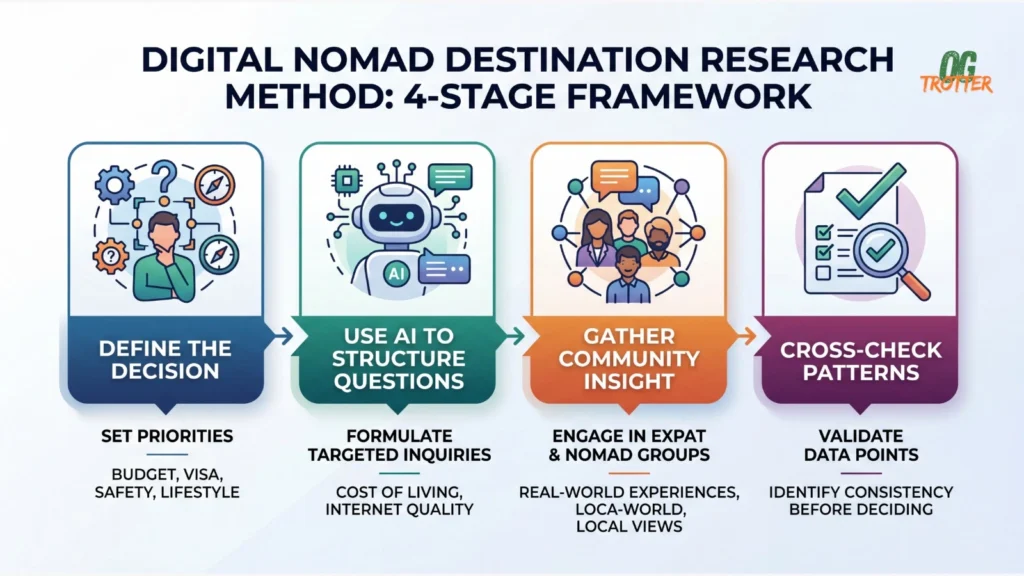
This is the method Sheri and I keep coming back to.
Not because it removes uncertainty. It does not. Nothing does. But it gives us a cleaner way to work through it.
1. Start with the right question, not the right platform
Most people begin by searching the destination directly. We begin by defining the decision.
Are we asking whether a city is good in general? That is too broad to be useful.
A better question is narrower and more honest:
Can we work well there for two months?
Can we sleep well there?
Does the city support focus or constant stimulation?
Is it good value at our budget?
Does it suit the season we are in?
The clearer the question, the easier it becomes to ignore irrelevant noise.
2. Use AI to structure the research, not replace judgment
AI is useful when treated as a research assistant, not an oracle.
We use it to help generate comparison frameworks, identify blind spots, summarize recurring themes, build question lists, and organize what we need to verify. It is especially good at turning vague curiosity into a sharper research process.
For example, instead of asking, “Is this city good for nomads?” we might use AI to break the decision into practical categories:
work setup, housing reality, walkability, transport friction, noise levels, healthcare access, neighborhood logic, weather impact, social texture, and long-stay sustainability.
That gives the research shape.
What AI should not do is make the decision for you. It can surface patterns. It cannot tell you what kind of daily life you are willing to live.
3. Use Facebook groups and communities for texture
AI gives structure. Communities give texture.
Facebook groups, niche expat communities, destination-specific forums, and smaller local groups can reveal what polished travel content usually leaves out: which neighborhoods actually suit different kinds of people, what newcomers tend to underestimate, how housing is behaving on the ground, whether café culture is friendly to working, what people complain about repeatedly, and what becomes easier once routine sets in.
But community insight needs filtering too.
The useful question is not, “What are people saying?” It is, “What patterns keep appearing across different people, and what context comes with those patterns?”
One complaint means very little. Twenty similar complaints from different types of residents deserve attention.
4. Cross-check everything that matters
Cross-checking is where the research becomes sane again.
If a claim matters to daily life, budget, safety, workability, or stress level, we try not to trust it until it shows up in more than one place.
If people say housing has become difficult, we compare listings, recent group discussions, and comments from people who arrived recently.
If people say a city is noisy, we look for whether they mean nightlife noise, traffic noise, construction, or thin-walled housing in specific neighborhoods.
If people say a place is expensive now, we ask: expensive compared with what, for whom, and under what standard of living?
The internet often gives broad conclusions where what you really need is operational detail.
Get your insurance quote right now and save 20%
5. Watch for emotional overstatement
This is a simple but important filter.
Posts written in a state of anger, panic, or evangelism often contain a grain of truth wrapped in too much certainty. A furious warning may point to a genuine issue. A glowing recommendation may reflect a genuinely good experience. But both need distance.
The question is not whether emotion invalidates the information. It is whether emotion is doing too much of the explanatory work.
When a post leaves no room for trade-offs, nuance, or reader fit, we treat it carefully.
How to tell the difference between signal and noise
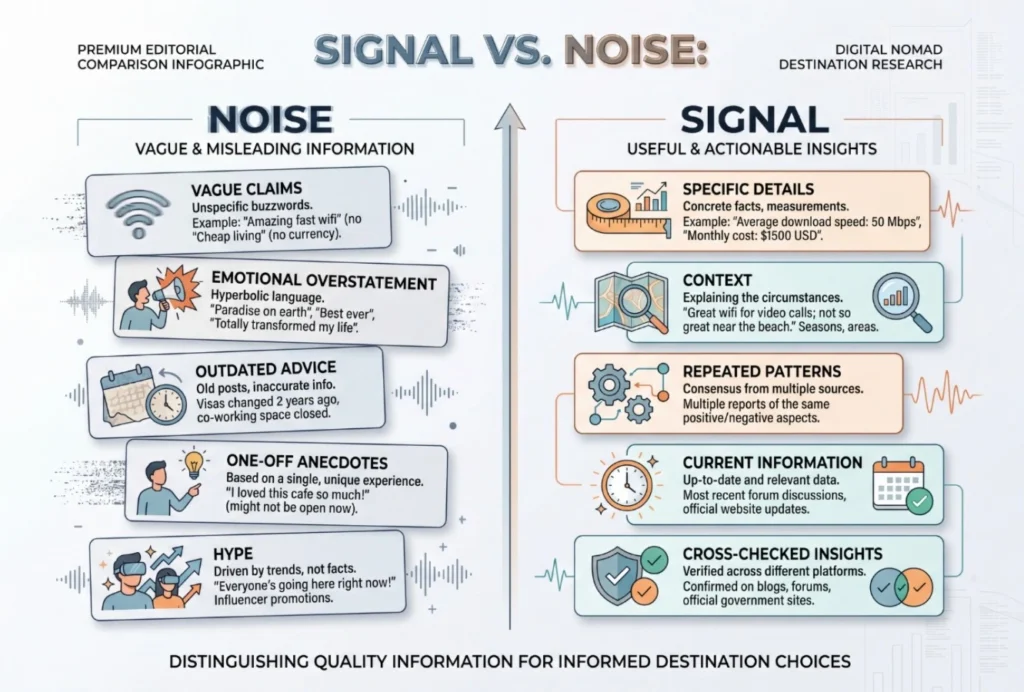
A useful signal usually has a few qualities.
It is specific. It tells you what is happening, not just how someone feels about it.
It is contextual. It explains when, where, for whom, and under what conditions the claim applies.
It is comparable. It helps you judge relative fit instead of making universal declarations.
It is current enough to matter. Even evergreen truths need time context when daily life conditions are shifting.
It is repeated across independent sources. Not copied, not echoed, but genuinely corroborated.
Noise usually works in reverse. It is vague, absolute, emotionally loaded, detached from context, and impossible to test.
“Lisbon is ruined.”
Noise.
“Rent pressure has changed the value equation in central Lisbon, especially for shorter stays without local housing knowledge.”
Signal.
“Chiang Mai is perfect for nomads.”
Noise.
“Chiang Mai remains unusually workable for people who prioritize affordability, routine, and low-friction daily life over novelty.”
Signal.
Good research is often less dramatic than bad research. That is part of the discipline.
Questions every nomad should ask before trusting destination advice
Before we give weight to a piece of advice, we try to ask a few quiet questions.
Who is this person, in practical terms?
A backpacker, founder, retiree, couple, long-term expat, party traveler, parent, freelancer, luxury traveler, first-time nomad?
When were they there?
Last month, last year, pre-pandemic, during peak season, during low season?
How long did they stay?
Three days and three months are different realities.
What were they optimizing for?
Cheapness, social life, beauty, deep work, dating, health, convenience, novelty?
Where exactly were they living?
Cities are often judged at the neighborhood level but discussed at the city level.
Compared with what?
A place that feels expensive to one person may feel reasonable to another depending on prior bases, currency, and standards.
Was this a pattern or an episode?
A recurring issue deserves more attention than a single dramatic inconvenience.
These questions do not make you cynical. They make you proportionate.
How to build your own decision framework
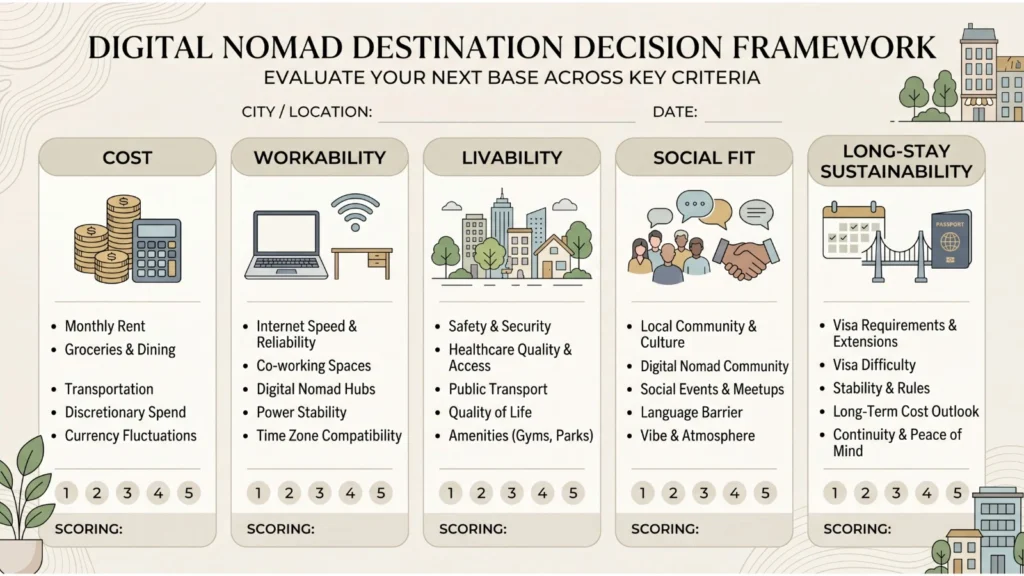
The best way to resist online noise is not to consume more content. It is to have a framework strong enough to sort it.
A useful personal framework can be surprisingly simple.
Start with five categories:
cost, workability, livability, social fit, and long-stay sustainability.
Then define what each one means for you.
Cost is not just rent. It is whether the city delivers enough value for your spending level.
Workability is not just Wi-Fi speed. It is whether you can actually focus, take calls, build routine, and protect your energy.
Livability is what daily life feels like once novelty wears off. Sleep, sidewalks, groceries, noise, transport, healthcare, weather, friction.
Social fit is whether connection feels possible in a way that suits your temperament, not someone else’s.
Long-stay sustainability is the bigger question underneath everything else: could you live here for weeks or months without gradually becoming less healthy, less focused, or less like yourself?
Once you know your categories, score sources against them rather than absorbing them whole. A YouTube video may be useful for street feel and pace. A Facebook group may be useful for recent housing reality. AI may be useful for structuring comparisons. A blog post may be useful for identifying recurring themes. None of them deserves unchecked authority.
That authority belongs to your framework.
Better decisions, better travel, better life
There is a quieter way to make decisions about where to go next.
It does not require ignoring the web. It requires using it with more discipline.
The internet can tell you what people fear, what they loved, what frustrated them, what surprised them, what they wish they had known. That is valuable. But it cannot live your life for you. It cannot decide what trade-offs are acceptable to you. It cannot tell you whether a city supports your work, your health, your rhythm, or the version of life you are trying to build.
That part remains yours.
And that is good news.
Because the goal was never to become immune to uncertainty. The goal was to become better at reading through it.
A better research system does not guarantee a perfect choice. It does something more realistic and more useful. It helps you move with clearer eyes, steadier judgment, and less dependence on the internet’s loudest voices.
That is often enough to change everything.
Summary
Online noise is now part of the digital nomad decision process whether you like it or not. The answer is not withdrawal. It is method.
Use AI to sharpen the questions.
Use communities to gather texture.
Cross-check claims that matter.
Watch for patterns, not just opinions.
Build a framework that reflects your real life.
The best opportunities are not always the ones most heavily promoted online. Sometimes they are the ones you would have missed if you had let fear, hype, or secondhand certainty do too much of your thinking for you.
FAQ
Why is online travel advice so overwhelming for digital nomads?
Because most digital nomads are evaluating several variables at once: cost, workability, safety, housing, social life, and overall fit. Online content tends to separate these factors poorly, exaggerate extremes, and present personal experiences as universal truths.
Is social media still useful for destination research?
Yes, but it works best as one input, not the whole system. Social platforms are useful for real-time texture, community sentiment, and practical observations. They are less reliable when treated as final verdicts.
How should digital nomads use AI when research destinations places?
Use AI to structure the process: generate questions, compare factors, summarize patterns, and identify what still needs verification. Do not use it as a substitute for judgment, community insight, or current ground-level context.
Why are Facebook groups still useful?
Because they often reveal practical, unpolished information about housing, neighborhoods, setup friction, and everyday problems that polished articles or short-form videos tend to skip.
How do I know whether a negative post is a warning sign or just noise?
Look for context, recency, specificity, and repetition. A negative post becomes more meaningful when similar concerns appear across multiple recent sources and apply to your kind of stay, budget, and lifestyle.
What is the biggest mistake people make when research destinations for a new base?
They borrow someone else’s conclusion without understanding that person’s priorities, timing, budget, and expectations. The better move is to borrow data points, then make your own conclusion.
Still deciding where to go next? Build your research process before you book the flight.
The smartest move is not finding more opinions. It is building a better filter. Start by creating your own destination scorecard with five categories: cost, workability, livability, social fit, and long-stay sustainability. The clearer your framework, the less power the noise has.
One Response